Friday, November 26, 2010

Badminton Court Size


 Badminton is a type of sport that uses a racket and is played in a designated area designed according to specifications set out for the game. The game can be played by two persons, called a singles; and two pairs of players, called a doubles.
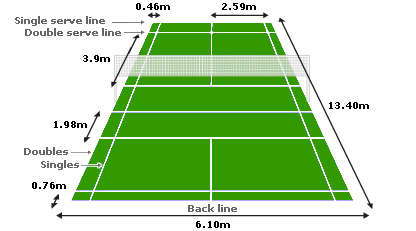
A badminton court size differs depending on the number of players. A singles badminton court should measure approximately seventeen feet wide and forty-four feet long; while a doubles court should have general measurements of twenty feet wide and forty-four feet long.
There is also a specific dimension for the net. For a badminton court, the height of the net should be at least five feet high. 
Playing the Game

Other than having the use of the appropriate badminton court built according to the mandatory specifications, you will also need a badminton racket and a shuttlecock.
A shuttlecock is sometimes referred to a birdie or bird. There are two kinds of shuttlecocks that you can use. One is made with feathers and has a cork cap on the bottom and one is made from plastic with a rubber cap on the bottom.
The racket is usually made of wood, plastic or light metal. A tennis racket may not be substituted for a badminton racket and vice-versa.
The game is very easy to play as you need only to strike the shuttlecock once your opponent hits it. You should not let the birdie hit the ground at all costs, otherwise, your opponent will score.

Basic Rules

To start the game the players will toss a coin to determine who serves first. Sometimes, the racket will be spun to decide on who gets to serve first.
During a game, players are not allowed to touch the net with their respective rackets. The shuttlecock should not rest on the racket. It is also not allowed to be carried on your racket.
If your shuttlecock hits the net after you serve and it comes across to your opponent’s net, the game still continues. However, if the shuttlecock is still within your opponent’s side of the net, you may not reach across and hit the birdie back to your opponent. You have to wait for it to cross over your net before you can hit.
If a serve is lost, this is referred to as a side out. In a class game, the games are played up to fifteen points while in a match, the game is played best of two out of three.

Friday, November 5, 2010

Front-Wheel-Drive Oversteer

It is generally perceived that front-wheel-drive cars - that is, cars in which the front wheels do both, put power to the road and steer - are understeering wrecks that fly off the road if you go into a corner too quickly. This is generally true, but it is possible to eliminate understeer and actually oversteer to a certain degree. Oversteering fun is not just the domain of rear-wheel-drivers.
Front-Wheel-Drive Oversteer
Oversteer is best practiced in an open area, and preferably on gravel so you can lose traction without much effort. You will not be able to hold a long, continuous sideways drift around a sweeping corner with a front-wheel-drive car like you can with a rear-wheel-drive vehicle, and you cannot use engine power on a high-horsepower car to start a "powerslide" since the power acts on the front wheels. But still, contrary to popular belief, oversteer is possible with a front-driver.


Video : Watch a Nissan Sentra attempt to catch a slide
WMV format / 203kb / 6 sec.
One way to induce oversteer in your front-driver is to plow hard into a corner and then lift off the throttle in the middle of the corner. Lifting off the throttle will cause the weight of the car to "shift" to the front, thereby putting more weight over the front wheels and, ultimately, adding more grip to the front tires. However, if you are lucky, the rear tires will lose traction and start to slide outwards while you're turning. You are now oversteering. Some countersteer now has to be applied to keep control of the slide, that is, steer in the direction of the slide. Learning to precisely "catch" a slide will take a lot of practice, so it is better to play around in an empty gravel lot or a slippery track with large run-off areas. Start off at moderate corner entry speeds and then increase this speed as you become more confident. This technique is only possible with well-balanced front-drivers such as an Integra or an old Sentra SE-R. If your car can achieve oversteer in this way, you will generally be cornering faster. Practice with lower entry speeds, and gradually increase it as you get confident.

Video : Watch a FWD European Ford Puma oversteer around a curve
WMV format / 158kb / 4 sec.
A brute-force way to induce a slide is to pull the handbrake (or press the e-brake) momentarily and yank the steering wheel in the direction of the corner, then countersteer. For example, to take a right-curving corner, you could plow into the corner in second gear and as soon as the corner starts, yank the steering wheel to the right and a split second later, pull the handbrake. The rear wheels will lock and suddenly lose traction. The car will quickly go it a sideways skid, at which point you quickly start countersteering. Now, before exiting the corner, release the handbrake. The front wheels of the car will just try to pull the car straight again and you'll have to steer exactly where you want to go. If you don't release the handbrake in time, you will spin. If done right, eventually you will center the wheel and straighten the car. Throughout the turn, keep the accelerator at a constant position, but you can apply a litle more throttle on the exit if you think you are spinning out. One hand should always be on the handbrake, with the button depressed, so you will have to turn with one hand. The sudden slide is a little hard to control on the first few tries and requires quick reflexes. And, as stated earlier, a continuous slide around the whole corner, like those done with rear-wheel-drive cars, is not possible with a front-driver. Pulling the handbrake to turn around a long radius corner will actually worsen your cornering time in most cases, so it is not a technique for road racing. But it can save you if speeding and understeering off a cliff is eminent. Front-Wheel-Drive Oversteer
Most cars on the road today are front-wheel-drive cars, from Acura to Volvo. The only rear-wheel-drive cars available nowadays are either impractical roadsters, exotic sports cars or overweight luxury cars. There are a number of well-balanced front-wheel-drive cars available that are actually easy to drive fast around corners. Examples include the RSX Type-S and legendary Integra Type-R from Acura, Celica GT-S from Toyota, SVT Focus from Ford, Sentra SE-R from Nissan, and the new Mini Cooper. Do note that not all front-wheel-drive cars are suitable for oversteering. Many cars, like the Infiniti G20 and Chevy Monte Carlo, are set up to understeer, sometimes aggressively so, because understeer is generally easier to control than oversteer for inexperienced motorists. The methods described here only serve as a general guide and will have to be adjusted according to the car you drive. There are other techniques too, such as left-foot braking and the pendulum drift, but these are harder and require their own space for discussion.
On a cautionary note, sliding a car not set up with substantial bracing might cause your car to fall apart! Practice on gravel, grass or in the rain, in an open area. Then adapt your car and your driving to handle the tarmac.
Modernracer.com © 2003

Monday, October 25, 2010

Budaya Minum Tapai


Masyarakat etnik di Sabah, khususnya Kadazandusun mempunyai sejarahnya tersendiri dari segi adat-istiadat, pantang-larang, pakaian tradisional, makanan dan sehinggalah meminum tapai. Amalan budaya turun temurun daripada nenek moyang ini menjadi ikutan sehingga sekarang. Walau bagaimanapun, budaya untuk memenggal kepala manusia sudah dihapuskan. Ini berikutan zaman sudah pun berubah dan pengembangan agama di kalangan masyarakat Kadazandusun menyedarkan mereka bahawa budaya `potong kepala’ adalah salah disisi undang-undang dan tidak boleh diamalkan lagi. Justeru itu, ramai masyarakat kadazandusun mengambil keputusan untuk menguburkan tengkorak-tengkorak yang selama ini diletakkan di atas pintu masuk rumah. Ada juga yang diambil oleh pihak Muzeum Sabah bagi tujuan tatapan genarasi muda sebagai satu bahan sejarah. Sabah sememangnya kaya dengan kepelbagaian etnik dan budaya. Tradisi minum tapai bukan sahaja menjadi kegemaran oleh suku kaum kadazandusun tetapi juga kaum Murut. Cara-cara membuat tapai hampir sama, tetapi dari segi adat istiadat mempunyai perbezaan yang ketara.

Kajian tugasan ini hanya memfokuskan budaya minum tapai di kalangan masyarakat kadazandusun di salah sebuah kampung dalam daerah Papar. Kampung yang di pilih ialah Kg. Langsat, Batu 6, Papar iaitu lebih kurang 9 kilometer dari Pekan Papar dan 49 kilometer dari Bandaraya Kota Kinabalu. Kampung yang dikaji ini, di diami oleh 98% masyarakat Kadazandusun dan 1% kaum Cina. Penduduk disini adalah penganut agama Roman Catholic, Buddha dan Islam. Penganut majoriti ialah penganut Catholic dengan 98 peratus. Budaya minum tapai masyarakat Kadazandusun di kampung ini tidak mengambarkan keseluruhan masyarakat Kadazandusun di daerah-daerah lain di Sabah. Ini kerana terdapat perbezaan budaya minum tapai dan cara-cara membuat tapai di daerah-daerah yang lain.

Budaya (culture) bermaksud cara hidup manusia. Ia merupakan satu proses perkembangan sahsiah, akal, semangat dan usaha manusia dalam sesuatu kelompok. Perkara ini dapat dilihat melalui etimologi perkataan "budaya" yang bermaksud " budi + daya "; yakni budi sebagai aspek dalaman manusia yang meliputi akal dan nilai, manakala daya sebagai aspek lahiriah manusia yang meliputi usaha dan hasilan. Maka pada kesimpulannya, budaya boleh difahamkan sebagai segala penghasilan masyarakat manusia dalam pelbagai bentuk sama ada yang dapat dilihat atau tidak. Konsep budaya merupakan satu konsep yang penting untuk membandingkan perbezaan antara suatu masyarakat dengan suatu masyarakat yang lain.

Kadazandusun merupakan nama kaum bumiputera asli yang terbesar di Sabah dan berasal daripada Indo-China. Kaum etnik ini menggunakan pelbagai bahasa dan dialek dengan pelbagai kebudayaan dan adat resam tradisional. Kumpulan etnik yang terbesar adalah suku kaum Dusun yang merupakan satu pertiga dari penduduk Sabah. Suku kaum Dusun yang tinggal di pantai barat seperti Penampang, Papar, Tuaran, Kiulu, Tamparuli, Tenghilan, Kota Belud dan juga di lembah bukit di Ranau, Tambunan, dan Keningau adalah petani tradisi yang menanam padi sawah dan huma

Menurut Persatuan Kebudayaan Kadazandusun Sabah (KDCA), Kadazandusun terdiri dari 40 etnik iaitu Bonggi, Lundayo, Sukang, Bundu, Makian, Sungei, Dumpas, Malapi, Tatana, Gana, Mangkaak, Tangara, Garo, Minokok, Tidong, Ida’an, Murut, Tindal, Kadayan, Nabai, Tobilung,
Kimaragang, Paitan, Tolinting, Kolobuan, Pingas, Tombonuo, Kuijau, Rumanau, Tuhawon
Lingkabau, Rungus, Tutung, Liwan, Sinobu, Bisaya, Lobu, Sinorupu, Lotud dan Sonsogon

Sumber : http://kdca.org.my/about/kadazandusun

THE LEGENDS

Until now, Kinabalu's name is still a mystery. The most popular view derives it from the Kadazan words, Aki Nabalu, meaning 'the revered place of the dead'. The local Kadazandusuns belief that their spirits dwell on the mountain top. Among the bare rocks of the summit grows a moss which early Kadazandusun guides said provided food for the spirits of their ancestor.
Many of the mountain's early explorers reported that their Kadazandusun guides performed religious ceremonies upon reaching the summit. Sir Hugh Low wrote that his guide carried an assortment of charms, pieces of wood, human teeth, and other paraphernalia weighing three kilograms (seven pounds) up to the summit. Whitehead recorded the slaughter of one white chicken.
These ceremonies were performed to appease the spirit of the mountain as well as the ancestral spirits who lived there. Nowadays, a ceremony is conducted annually by the Kinabalu Park's guides. Seven chicken and eggs, as well as cigars, betel nuts, sirih leaves, lime and rice are sacrificed, and later enjoyed by the guides.
Another theory about the mountain's name comes from the derivation of Kina meaning "China" and Balu, meaning "widow". A Kadazandusun legend tells the story of a Chinese prince ascending the mountain. He is seeking a huge pearl on the top which is guarded by a ferocious dragon. The prince succeeds in slaying the dragon and stealing the pearl. He then marries a Kadazan woman, but soon abandons her and returns to china. His wife, heartbroken, wanders to the mountain to mourn. There she was belief to turn into stone.

KADAZANDUSUN BELIEFS

An ancient mythology lies at the heart of Kadazandusun culture. A Kadazandusun creation myth tells how the supreme deities Kinohiringan and his wife Umunsumundu made the earth while Kinohiringan created the sky and the clouds. But the clouds were smaller than the earth and Kinohiringan was ashamed. To save his pride, Umunsumundu reshaped the earth, making it smaller, and thus created Mount Kinabalu, the mountain that we know today.
A Kadazandusun story tells of a giant king named Gayo Nakan ('big eater') who lived at the base of the mountain. His people tired of his enormous appetite and were had pressed to feed him. Hearing their complaints, the king told them to bury him alive at the top of the mountain. Bringing all their tools they laboured in vain, until the king uttered magic words and sank into the rock up to his shoulders. He then told his people that, due to their lack of patience, drought and famine would afflict them - but promised to help them in times of war. Fearful and penitent, the people made their first sacrificial offerings at the wishing pool below the summit that was Gayo Nakan's grave.

The Meaning of the Flag of Sabah

http://www.sabah.gov.my/pd.nbw/dcm/English/engdoc/flag.html